"There are three rules for writing the novel. Unfortunately, no one knows what they are." W.Somerset Maugham
Showing posts with label polygamy. Show all posts
Monday, October 3, 2016
Monday, September 5, 2016
Foreword Magazine's review
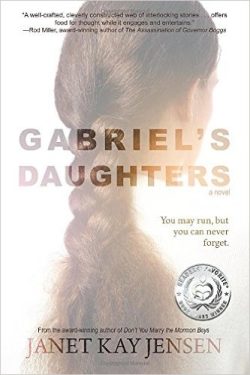
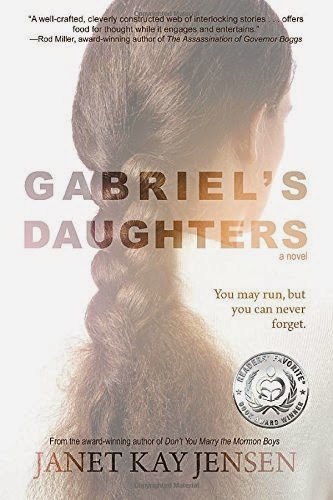
Gabriel's Daughters

Reviewed by Michelle Anne Schingler
Gabriel’s Daughters is a lovely and optimistic story about the uncrushable nature of women’s spirituality.
Janet Kay Jensen’s Gabriel’s Daughters is the imaginative tale of a young girl who breaks away from the expectations of her rigid religious community to live a life with more possibilities.
At sixteen, Zina knows that her artistic dreams will have to be put on hold soon so that she can marry Cyrus, a friend of her father’s. But Zina is resistant to the prescriptions of her polygamous Utah community and craves a future full of passion. Her ambivalence leaves her vulnerable to the sweet-talking of a handsome young Gentile teacher. At risk of communal exile, she flees into the wider world, where she must challenge all of her taught notions of right and wrong.
The narrative pits polygamist traditions against more welcoming Christian belief systems, from the emotive Protestant church where Zina first finds refuge to a more modern articulation of Mormonism than that she first knew. Zina is not the only woman from Gabriel’s Landing to question how she was raised; two sisters also resist the roles assigned to them. Moments devoted to their barrier-breaking are fascinating in the text, which openly celebrates women’s dreams without insisting that they must abandon all beliefs to pursue them.
But those optimistic explorations also lead to some less-than-believable moments in the story, which always seems designed to afford Zina a wealth of opportunities. Her fortunes are incredible: she finds work and shelter immediately, even as a pregnant, teenage runaway, and is able to complete school with ease. A friendly young man with an art-laden apartment shows up offering her a room, rent free, when she needs it; later she inherits millions from a woman whom she knew only briefly. Even her grand struggles dissipate quickly, including her resistance to the love of a kind man.
The lack of suspense is consistent, and sometimes at odds with the story itself, which takes many dramatic turns, including a brutal assault and a kidnapping. There is never much doubt that Zina and her family will prevail and that forgiveness is always at hand. Where the story concentrates on Zina as a vulnerable and growing young girl, it is a successfully sweet foray into women’s religious lives; where it strives for more incredible turns, it strains credulity, sometimes beyond reason.
Years pass quickly, and kind characters move in and out of the story with ease and gentle presence. Prose is both swift and self-consciously affecting. Characters are somewhat formulaic, particularly black and gay characters, who are subject to light, if nonhostile, caricaturing. The text works to celebrate differences, if it does not always do so with much depth.
Speeches around personal progress are preachy, but they also result in small, happy redemptions. Zina herself grows into a woman of presence, and other characters develop in a similar style, always emerging from their challenges as more well-rounded, and eternally hopeful, people. The result is a cast that is lovable and admirable, if not always believable. Happily-ever-afters are never much in doubt, but those who come to the tale for its spiritually cheerful core are likely to still find much about the conclusions in Gabriel’s Daughters to celebrate.
Gabriel’s Daughters is a lovely and optimistic story about the uncrushable nature of women’s spirituality.
Disclosure: This article is not an endorsement, but a review. The author of this book provided free copies of the book and paid a small fee to have his/her book reviewed by a professional reviewer. Foreword Reviews and Clarion Review make no guarantee that the author will receive a positive review. Foreword Magazine, Inc. is disclosing this in accordance with the Federal Trade Commission’s 16 CFR, Part 255.
Wednesday, June 24, 2015
Body, Mind and Spirit: Gabriel's Daughters wins prestigious design award
June 17, 2015
Santa Fe, New Mexico
Gabriel's Daughters won first place honors in the "Body, Mind and Spirit" category of the prestigious Southwest Book Design and Production Award.
Entries came from five southwestern states.
The awards were presented at the annual New Mexico Book Association Gala in Santa Fe, New Mexico.
Entries came from five southwestern states.
The awards were presented at the annual New Mexico Book Association Gala in Santa Fe, New Mexico.
Congratulations to the team at Jolly Fish Press!
The Southwest Book Design and Production Award
is sponsored by
Tuesday, May 5, 2015
An Interview with Johnny Worthen, In Which I Hold My Own .....
THE BLOG MANSION THURSDAY, DECEMBER 18, 2014
Janet Kay Jensen, Gabriels' Daughters, and The Danites
Author Janet Kay Jensen is from Utah which means that like the rest of the denizens of that odd state, she knows about polygamy.
It’s a dirty little secret in this neck of the woods, a taboo subject in many places. I was excited to talk to Janet about her new book Gabriel’s Daughters that deals with this sensitive subject in an adult and tender manner.
Johnny: Are you completely mental?
Janet: What do you mean?
Johnny: This is Utah, you don’t talk about this stuff. It’s like fight club. What’s the first rule of Fight Club?
Janet: Don’t talk about Fight Club?
Johnny: What’s the first rule of living in Utah? Janet: It’s hard to get a drink? It’s a great place for orthopedic surgeons because we have fabulous mountains for skiing? Or there are beehives on our state flag and the seagull is our state bird, even though we’re landlocked? That if out-of-shape grown men participate in Church basketball and try moves they haven’t made since high school, they’ll end up in the ER? Stay off I-15 unless it’s noon-2 p.m. Utah has two seasons; winter and construction. There are many rules here. Many are unwritten.
![]() |
| construction season in utah |
Johnny: Well, yes that’s right, especially the one about the seasons, but there’s a rule somewhere about not bringing up Utah’s ugly history. Like the Mountain Meadow Massacre. Just mentioning it on a blog will bring Danites to you door.
Janet: I don’t think it’s that bad. We make the New York Times with some regularity. It’s out there. The good stuff and the not-so-good. Utah and the LDS church are beginning to acknowledge and own the not-so-good history, which is great progress. But everywhere I’ve lived, the locals cringe about anything that makes them look less than stellar in the national news. Personally, I squirm when someone from Utah does something idiotic that makes the national news. I won’t name names. But there are idiots in every state of this great nation. So you have to get a perspective. And, seriously, if there are stories about our people to be written, it’s not a bad idea to write them ourselves. We often have an emotional connection.
Johnny: Did you hear that?
Janet: The doorbell?
Johnny: Yes.
Johnny: A Danite.
Janet: He looks like a missionary.
Man at door: Would you like to know more about our church?
Janet: See.
Johnny: Don’t you believe it. Are you a Danite?
Man at the Door: Yes sir, I am.
Johnny: Wait outside, I’ll be with you in a minute.
Danite: Our spies say you mentioned the Mountain Meadow Massacre. Can you confirm this? What exactly did you say? Who’d you blame for it?
Johnny slamming door: Later. Now out.
Janet: How’d you know?
Johnny: He’s alone. Missionaries travel in pairs.
Janet: Right. He also looks hungry.
Johnny: So we don’t have much time. They’ll come back in greater numbers. Tell me about Gabriel’s Daughters.
Janet: Gabriel’s Daughters continues the story lines of my first novel, Don’t You Marry the Mormon Boys. There is one daughter, Zina, who has disappeared in the first book. The second book is about her decision to flee the family she loves rather than marry into
polygamy. As she’s only 16, she has a lot to learn about the world, and the book takes us on her journey. But no matter what she accomplishes or where she goes, she can’t break the longing for family, and she has to recognize that before she can completely become the person she wants to be. She has to make peace with her history and find a way to relate to the people she loves. Johnny: What personal experience do you have with polygamy?
Janet: None. My husband has one wife and that’s me. He says that’s more than enough. It’s in my genealogy, though. His, too. Also, years after high school, I realized that one of my classmates—a bright, well-mannered, quiet boy, had been raised in polygamy. But when I knew him, I had no clue. Throughout the years I followed him and his family through occasional newspaper stories and read two books his sister wrote. The more I learned, the more I was intrigued, and the more books I read on the subject.
Johnny: I understand you walk a fine line on the subject not wholly condoning and not wholly condemning. Do you do this because you’re afraid of the Danites?
Janet: I suppose it can be a choice of consenting adults to practice polygamy. But children who grow up in the culture lack education and skills to function in the world of the “Gentiles,” and they don’t know all the choices they really have in the outside world. Girls, especially, often don’t think they have any option but to marry young and become entrenched in the lifestyle. That’s where my concerns lie.
Johnny: It’s a timely book. The horrors of the FLDS still make the news pretty regularly. Do you have a character like Warren Jeffs in Gabriel’s Daughters?
Janet: Nope. I have a Council of Brothers who govern all manners temporal and religious. They’re also related to each other through numerous marriages. In Gabriel’s Landing there are trees that don’t fork. They’re very serious, well-acquainted with their scriptures, and lack any sense of humor… But have I told you about my grandchildren?
Johnny: How do you approach the religious element of polygamy in your book?
Janet: It is explained as a choice made by some LDS (Mormons) around 1890, when Utah attained statehood by renouncing polygamy. Some formed splinter groups that still exist today, and that is Zina’s heritage. They feel it is a fundamental doctrine that the mainstream church abandoned.
Johnny: Oh, there it is. There’s a pack of them now.

Janet: They’re so young. Are you sure they’re not missionaries?
Johnny: It’s still an odd number, but I admit the white short-sleeve shirts are a little disconcerting.
Janet: Lots of acne too. Eager looks on their faces.
Johnny: But I bet they’re armed to the teeth.
Janet: You’re paranoid. But I have a Border/Beagle named Gus who could be a diversion. Give those guys a few tennis balls and Gus will wear them out playing fetch. Well, actually, he keeps and guards all the balls he catches…...
Johnny at the window: Hey Danites! Are you armed to the teeth?
Danites: Yes.
Johnny: Told you. So Janet, I’m always curious how authors got to be where they are. How’d you go from a scribbler to a published author?
Janet: I grew up in a family where reading was important. My parents went back to school when my older sisters started college, to finish their own educations. Eventually they both got master’s degrees: my father’s was in history and political science and my mother’s was in library science (now called instructional technology).
My training and career were in Speech-Language Pathology but I always felt a creative need was being suppressed. I’d occasionally read a book and say “I could have written that better,” so one day I sat down and tried. Then I was approached by another writer in my chapter of the League of Utah Writers, Shaunda Wenger, who is a voracious reader and a fabulous cook. I am one of the above. Her concept was a co-authored literary cookbook, and millions of books and hours in the kitchen later, The Book Lover’s Cookbook came to be. It’s a lovely book. Lovely to read, as it contains passages from famous literature, and great for cooking, as the original recipes match the food mentioned in the books. It’s like cooking with your favorite authors and characters.

By the way, funeral potatoes snuck in there. Astute cooks will recognize them another name. No green jello, though. And no fry sauce. We did have our standards. When The Book Lover’s Cookbook was published, I went back to working on Don’t You Marry the Mormon Boys. It became unmanageable because I was trying to tell two stories at one time, and they involved two different characters, 10 years apart in chronology. So I had to kick Zina out of the book and promise that she’d get her own. That’s how Gabriel’s Daughters came to be. I think Zina has forgiven me.
Johnny: They’ve started to sing hymns. We haven’t much time.
Janet: Why are there so many? Pus, they’re singing out of tune.
Johnny: Well beside my mention of Mountain Meadow, your book not only deals with polygamy and Mormonism and modernity, but also touches upon homosexuality. Such things attract Danites like a magnet. How do you deal with homosexuality in your book?
Janet: There is a character, Simon, who’s a great guy. He’s also gay and in need of a roommate. Zina, he thinks, would be perfect. He senses she has trust issues with men, and he’s nonthreatening. He’s also a great mentor for Zina, and has a fabulous art collection. He’s been kicked out of his family, so he knows what it’s like to feel like an orphan.
Johnny: Powerful social commentary. I can’t wait to see it. I hope you’re around to reap all your accolades.
Janet: Why wouldn’t I be?
Johnny: Danites.
Janet: Oh right.
Johnny: In case you don’t make it, where on the internet can my readers find out more about you and your book?
Janet: Amazon Barnes & Noble Goodreads Facebook Twitter Blog Email
Johnny: They’ve got a battering ram.
Janet: What are we going to do?
Johnny: Hide in the Blog Mansion and hope they don’t find us. Wait for them to leave.
Janet: What if they find us? What will they do to us? Johnny: It’s terrible. you don’t want to know. That last time they got in…
Janet: What?
Johnny: It’s too horrible to tell.
Janet: What…? Listen, I’ve been a soccer mom and a PTA president and even a Cub Scout Leader. My parents met at a debate meet. My partner took state in debate my senior year. I met my future husband when we were both members of Utah State University’s debate team. I am fierce.
Johnny: They made me eat funeral potatoes and green jell-o with carrots!

Janet: Oh my god. The horror! You see, green jell-o should also be made with crushed pineapple and maybe even bananas. Cool Whip on the top. Listen, grab a copy of The Book Lover’s Cookbook and hold it up. That might frighten them off. By the way, did you know there are more than a dozen variations of funeral potatoes? The perfect fast comfort food for the masses.
Johnny: Yeah, I know. Hide!

Side note from Janet: One of my sons lives in Finland. It’s a tradition to bring a cake to work on your own birthday. So he called me for help. He was standing in the American section of a supermarket and wanted to make sure he had all the ingredients. I haven’t heard how Grandma Ann’s 7-Up Salad was received by his co-workers yet, but I can guarantee it was their first experience with it. The Finns are so advanced, they don’t even have Jell-o. Although I have tasted a dish similar to funeral potatoes in Finland. I was too polite to tell them what we called it. Plus, you never know how American English is going to translate into Finnish.
Posted by Johnny Worthen Read the original post here:
http://johnnyworthen.blogspot.com/2014/12/janet-kay-jensen-gabriels-daughters-and.html
Friday, April 24, 2015
Friday, April 3, 2015
Gabriel's Daughters: A Review
"Jensen has a light touch and takes a more academic and philosophic approach than a dogmatic or moral one to these issues."
When a young, handsome teacher
pays particular attention to sixteen-year-old Zina Martin, she believes she has
found true love. Imagine her horror when she discovers her father has arranged
a marriage for her to his friend, a middle aged man who already has four wives.
When her lover accepts a job on the other side of the country and leaves
without her before she can share the news she is pregnant, her world falls
apart. The man she thought she loved never really loved her, but only used her.
She won’t marry the man her father has chosen for her, a man she doesn’t love.
Staying in the small polygamous
town she’s lived in all of her life isn’t an option. She runs away and is
fortunate to be picked up by a long haul trucker and his wife on their way
through Utah to Chicago. As she struggles to understand who she is and
determine her own values she learns the “gentile world” is nothing like she has
been taught by her family and leaders of the small religious community that had
been her whole world prior to her leaving. Good and evil can exist anywhere.
She misses her family and longs to reconnect with them beyond the postcard she
has post marked from various cities that simply says she’s fine.
When an Internet search leads her
to the first information she has had of her family in years, she faces her need
to reconnect.
Trust and security issues play a
major role in this novel. As do several modern hot button issues including
race, homosexuality, polygamy, sexual predators, and homeopathic medicine. Jensen
has a light touch and takes a more academic and philosophic approach than a
dogmatic or moral one to these issues. With strong characterization, the author
gives a picture of many pieces of America from a rural western community locked
in the past with its joys, sorrows, and abuses, then a low to middle class, big
city, black neighborhood, a sophisticated pent house and artistic life style
offered in Minneapolis, a backwoods southern community straddling the line
between the old and the new, to bits and pieces of Salt Lake City with its
recognition of its changing demographics.
Janet Kay Jensen is a long-time
educator who now lives in Logan, Utah, and in addition to being a full-time
writer volunteers as a literary tutor.
Reviewed by Jennie Hansen, Meridian Magazine March 2015
Monday, December 15, 2014
Blog tour: Gabriel's Daughters
Gabriel's Daughters: A novel by Janet Kay Jensen
Wrestling
with issues of polygamy, homosexuality, and modernity, Gabriel’s Daughters
examines them through the lives of the large, loving, and polygamous Martin
family. The story is told primarily through the eyes of Zina Martin, a young
girl who—upon discovering she is impregnated by her “sterile” teacher and will
soon be married off to a man three times her age—escapes the enclosed
polygamous town of Gabriel’s Landing, Utah. Zina then embarks on a journey of
self-discovery, yet she can never fully escape the longing she has for her
family and even the controversial and outdated lifestyle she once lived.
Through both tears and triumph, Gabriel’s Daughters reveals a moving story that
not only acts as insightful social commentary but also prompts readers to
re-evaluate their lives.
A few characters from Gabriel's Daughters
Janet
Kay Jensen is the co-author of a literature-based cookbook, The Book Lover’s Cookbook: recipes inspired
by great works of literature and the passages that feature them (Wenger
& Jensen), and an award-winning novel, Don’t You
Marry the Mormon Boys.
She
holds degrees in Speech-Language Pathology from Utah State University and
Northwestern University and worked in the
education field for more than twenty years. She has taught writing courses at the local jail and is also a volunteer literacy tutor who feels genuine panic when caught without something to read.
Janet
and her husband Miles, an attorney, live a quiet life in a
college town nestled in the foothills of northern Utah's Rocky Mountains. They are the parents of three grown sons: a soccer enthusiast/physician in Salt Lake City Utah; an exercise physiologist/graduate
student in Jyvaskyla,Finland; and a parachute jumper/embedded systems engineer in
Berkeley, California. They have happily become grandparents of three remarkable
grandchildren.
Contact the author:
email: janetkayjensen@gmail.com
blog: www.janetkayjensen.blogspot.com
facebook: https://www.facebook.com/janet.k.jensen
https://www.facebook.com/JanetKayJensenAuthor
Twitter: @Janet KJensen
Gabriel's Daughters
Author: Janet Kay Jensen
Contact the author:
email: janetkayjensen@gmail.com
blog: www.janetkayjensen.blogspot.com
facebook: https://www.facebook.com/janet.k.jensen
https://www.facebook.com/JanetKayJensenAuthor
Twitter: @Janet KJensen
Gabriel's Daughters
Author: Janet Kay Jensen
- Paperback: 328 pages
- Publisher: Jolly Fish Press (January 20, 2015)
- Language: English
- ISBN-10: 1939967198
- ISBN-13: 978-1939967190
- Product Dimensions: 9.6 x 6.6 x 0.8 inches
Saturday, May 4, 2013
An excerpt from Gabriel's Daughters
"Amy was everything one could want in a daughter: thoughtful, nurturing, soft-spoken, and well-trained in the domestic skills she would need for her future. She could often be found holding a niece or nephew in her arms, singing or reading to them. 'That youngest daughter of yours will make a fine wife and mother,' he had heard many times from admiring men. However, comments like that from his contemporaries had begun to disturb him. Amy was young; his peers were growing old."
Gabriel's Daughters
Friday, October 12, 2012
Designing a literary family tree
Okay. So, with artistic/cover/marketing ideas in
mind, my publisher, Jolly Fish Press, suggests I come up with a family tree for Gabriel's Daughters, the novel they will publish in Fall 2013. I think - - -
wow, what a great idea. How creative! Because Gabriel's Daughters is about a family. In particular, a large
polygamous family. One husband, three wives, and seventeen living children, to
be exact. (I should be very grateful they didn't ask for a genetic analysis. Two of the wives are identical twins, so their children are half siblings to each other as well as cousins, and the other wife is a cousin to the identical twin sister wives. It would just boggle the mind.)
Knowing my artistic limits, I turn to Google to find a
family tree maker. My mother was a genealogist and she’d be so
disappointed. I haven’t done any family
research of my own to speak of, and here I am, constructing a family tree, not
just for someone else’s family, but an imaginary family. Sorry, Mom . . . however, she always wanted to write a book, so maybe that's a bit of comfort for me.
Anyway, I start entering information on my hypothetical
family into the family tree maker. The first glitch comes when I try to add Wife #2. Am I certain I want
to add a second wife, the program asks? Yes, I am. Then I add Wife #3 after
answering the same question.
Then I think, Okay, I should name these people. Of course,
some are main characters in my book and they already have names: Joshua Martin
and his three wives, Rachel, Hannah and Sarah. The book centers on daughters Louisa,
Zina, and Amy. We know there are other children, but they’re basically just
placeholders (I know Dickens would involve all of them in the story if he'd written it, but he didn't, and I'm not Dickens). However, to make
this family more authentic in my mind at least, I start inventing and naming children and assigning
them to the various wives.
Then I think, well, I’ll find pictures for these people. That
would look great on this hypothetical family tree I’m constructing. So I start with Joshua in mind, go to Google Images and start hunting for “pictures of mature men.” Oops. While there are definitely some mature men pictured, some are sans clothes. So I refine the terms a bit
and finally find someone who looks the way I think Joshua would look. Fully clothed.
For the sons, I locate a few images of clean-cut boys, resisting the urge to include pictures of my own three sons. Nope, not gonna go there. Not that they'll ever see this work of art I'm pasting together. It's just the . . . well, the Principle of the thing (inside joke: polygamists refer to their lifestyle as living the Principle).
Then I search for pictures of girls for the daughters. Whoa
again. Mixed among pictures of regular
girls are the “girly” pictures you’d see in girly magazines. So I try “modestly
dressed girls” and find some pictures I think will work.
Next come the wives. And that’s more challenging, because Joshua and his wives and seventeen children live in a small isolated polygamous community and dress like . . . well, like pioneers. So I Google “polygamous women” and find pictures from the raid on the FLDS cult's YFZ Ranch in Texas. There they are, groups of women, in their long pastel dresses (only two or three styles). Evidently the color indicates family lines. And the hair! Long, up in the back, with a big, high swoop in the front. The higher the swoop, the better, according to what I’ve read. Well, my polygamists aren't FLDS and they don’t quite look like that. However, the women do have long hair, and it’s always worn up, never loose, and they do wear modest, long dresses. I find a few pictures of women that will do, I think.
Then, scanning across the images on the screen, I see one that is
vaguely familiar. I stop, back up, and look again. It’s a woman with three dogs. She actually
looks quite familiar. In fact, it’s a picture of me, with my three dogs, and it’s
popped up under the search term for “polygamous women.”
Whoa again. I’m not a polygamous woman. Never have been,
never will be. My husband says one wife is more than enough. I agree. We've agreed on that for more than forty years. I click on the
picture and it leads to this blog and the press release for Gabriel’s
Daughters, which is, after all, about polygamy, among other things. OK, that’s all right, I
guess, after I get over the shock.
Just be careful when searching for pictures of men, women,
boys and girls on the web. You’ll find much more than you bargained for.
And, when it comes to the internet, you never know where you’ll show up.
Friday, August 28, 2009
Don't You Marry the Mormon Boys - review and interview
Visit Cami Checketts' blog today. She's written a review and interviewed me about Don't You Marry the Mormon Boys. Click on the title of this post, leave a comment her blog and you could win a free copy of the book!
Thanks, Cami!
Thanks, Cami!
Subscribe to:
Posts (Atom)


+-+Copy.jpg)


.jpg)
.jpg)